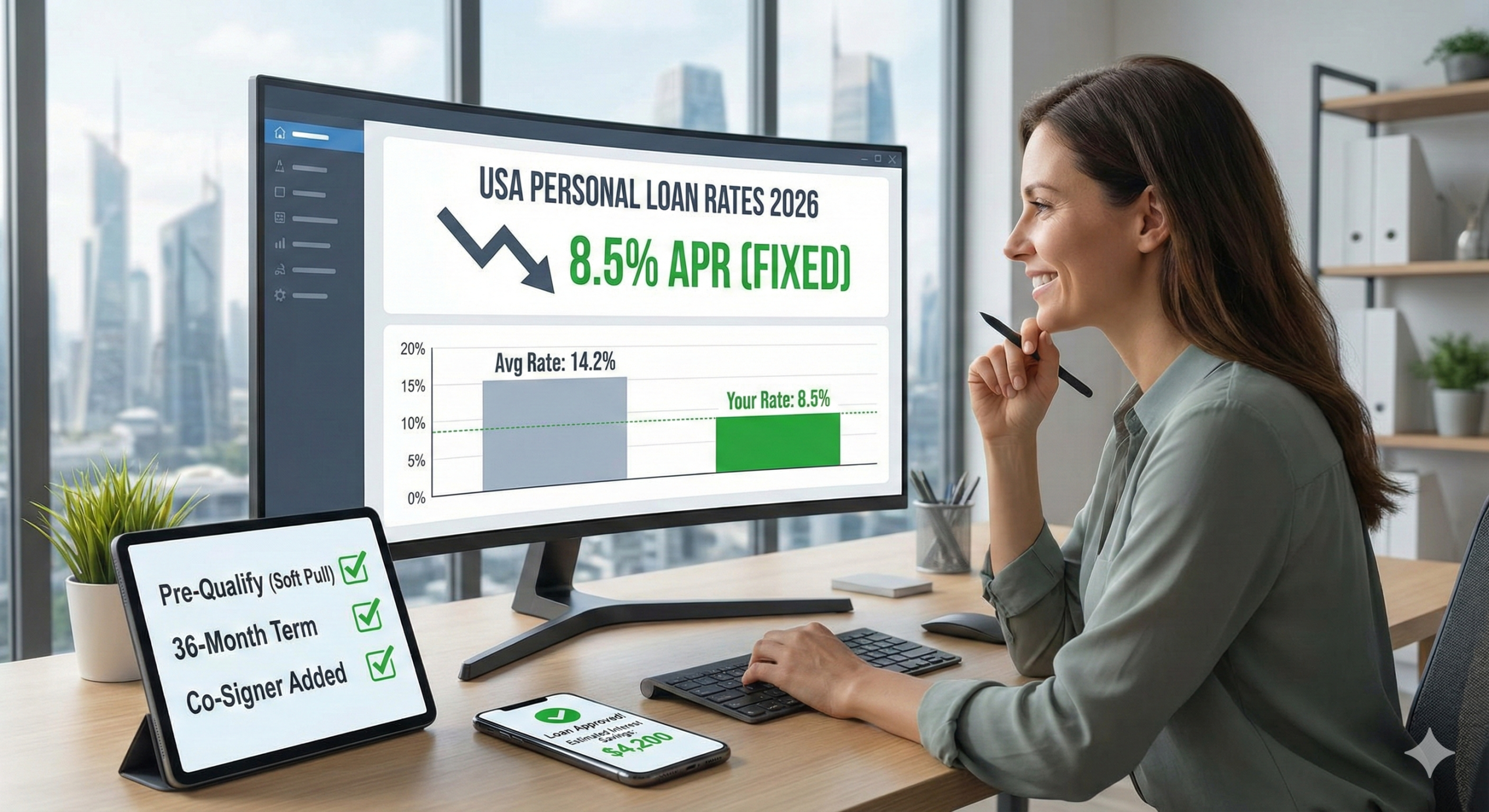
In 2026, personal loans continue to be a go-to option for Americans needing quick, unsecured funding. Whether for debt consolidation, home improvements, medical expenses, emergencies, or major purchases, these loans offer flexibility without collateral in most cases.
The current financial landscape features elevated but stabilizing interest rates after the Federal Reserve’s adjustments in late 2025. With the fed funds rate holding steady at 3.50-3.75% as of early 2026 and modest cuts possibly on the horizon later in the year, personal loan APRs have shown slight declines but remain higher than pre-pandemic levels.
This complete guide covers the latest personal loan interest rates in the USA for 2026, key influencing factors, 2026 forecasts, and proven strategies to secure the lowest APR possible.
Current Personal Loan Interest Rates in the USA (February 2026)
As of early February 2026, average personal loan APRs vary by credit score, loan term, amount, and lender type. Here’s the breakdown from reliable sources:
- Overall Average APR: Around 12.26% for a typical $5,000 loan over three years with a 700 FICO score (Bankrate data as of late January 2026).
- By Term (Credible marketplace data, week ending Jan. 25, 2026):
- 3-year loans: 13.06% average.
- 5-year loans: 18.46% average.
- Short-term rates: Commercial banks report around 11.65% for 24-month loans (Federal Reserve data, trends stable into 2026).
- Range: From as low as 6.49% (with autopay and excellent credit) to 35.99%+ for higher-risk borrowers.
Average APR by Credit Score (approximate, based on NerdWallet, Credible, and Bankrate data):
| Credit Score Range (FICO) | Rating | Average Estimated APR (3-Year Term) |
|---|---|---|
| 720–850+ | Excellent | 10.5% – 13.5% (as low as 10.87%) |
| 690–719 | Good | 13.5% – 17.0% (around 14.48%) |
| 630–689 | Fair | 17.5% – 23.0%+ |
| 300–629 | Poor | 25.0% – 36.0%+ |
Excellent-credit borrowers can often secure single-digit or low-double-digit rates, while fair or poor credit pushes APRs higher. Shorter terms (2–3 years) typically offer lower APRs than longer ones (5+ years) due to reduced lender risk.
Top Lenders with Lowest Starting Rates (February 2026):
- LightStream: Starting at 6.49% APR (with autopay; no fees, competitive for excellent credit).
- Wells Fargo: As low as 6.74% APR (with relationship and autopay discounts).
- SoFi: From 8.74% APR (with discounts; strong online option).
- Others like PenFed, Upgrade, and Discover frequently rank high for qualified borrowers.
Rates are influenced by the Federal Reserve, but personal loans respond more to borrower risk than Treasury yields.
2026 Forecast: Will Personal Loan Rates Drop?
The outlook for the rest of 2026 points to stabilization rather than sharp declines:
- Fed Policy: After holding steady in January 2026, analysts expect modest cuts (possibly 1–3 quarter-point reductions) in Q3/Q4, but nothing aggressive.
- Lender Trends: Banks are maintaining conservative standards, so qualifying for the lowest advertised rates remains competitive.
- Projected Average: Bankrate forecasts around 12% for 2026 (slight dip from late 2025), with lows near 11.8% and highs at 12.2%.
Waiting for big drops may not pay off—focus on optimizing your profile now for the best shot at low rates.
Factors That Affect Personal Loan Interest Rates in the USA
- Credit Score — The biggest factor; higher FICO (especially 720+) unlocks the lowest APRs.
- Debt-to-Income (DTI) Ratio — Lenders favor DTI below 36% (ideally <30%).
- Income & Employment Stability — Steady, high income signals low risk.
- Loan Amount & Term — Shorter terms and moderate amounts often mean lower rates.
- Lender Type — Online lenders/fintech (SoFi, LightStream) offer competitive rates; credit unions may beat banks for members.
How to Get a Low-APR Personal Loan in 2026 (5-Step Strategy)
In this environment, proactive steps can save thousands in interest.
- Use the Pre-Qualify Strategy Start with soft-credit-check tools on sites like Bankrate, NerdWallet, Credible, or LendingTree. Prequalify with 4–6 lenders (online + credit unions) to compare offers without dinging your score. Variance can be huge—one might offer 12% while another quotes 18%.
- Choose a Shorter Term Opt for 24–36 months if affordable. This reduces lender risk, often cutting APR by 2–4% vs. 60+ months, though monthly payments rise.
- Boost Your Credit & Lower DTI
- Aim for 720+ FICO: Pay bills on time, keep credit utilization <30%, dispute errors (free reports at AnnualCreditReport.com).
- Reduce DTI: Pay down credit cards before applying.
- Add a co-signer with excellent credit if needed (drops rates significantly, but they’re liable too).
- Hunt for Discounts & Secured Options
- Autopay: 0.25–0.50%+ reduction common.
- Relationships/direct deposit perks.
- Secured loans (e.g., via credit unions, using savings/CD as collateral): Can slash 5–8% off unsecured rates for fair credit.
- Shop Smart & Apply Strategically Compare total costs (APR + origination fees 0–8%). Apply within a 14–45 day window so inquiries count as one. Avoid high-fee lenders unless the rate justifies it.
Things to Watch Before Applying
- Origination Fees: 1–8%; calculate if a lower-APR loan with fees beats a higher one without.
- Prepayment Penalties: Rare, but check.
- Fixed vs. Variable: Most are fixed—prefer for predictability.
- Scams: Stick to reputable lenders; beware fake sites promising guaranteed approval.
Final Thoughts
Personal loans in 2026 remain a smart tool for consolidating high-interest debt (credit cards average ~20%+) or funding needs, but success hinges on preparation. With averages near 12–13% and lows under 7% for top profiles, aggressive shopping and credit optimization can land competitive financing.
Start today: Check your credit, prequalify with multiple lenders, and only borrow what you can repay responsibly. Rates change—verify directly with lenders for personalized offers.
Ready to shop? Use prequalification tools for no-risk rate checks and find your lowest-APR personal loan in 2026!